Many psychologists feel conflicted about visibility
On one hand, being found feels necessary.
On the other, most marketing approaches feel uncomfortable, unethical, or misaligned with clinical values.
If you want a sustainable private practice without compromising professional integrity, this guide was created for you.
What this guide IS
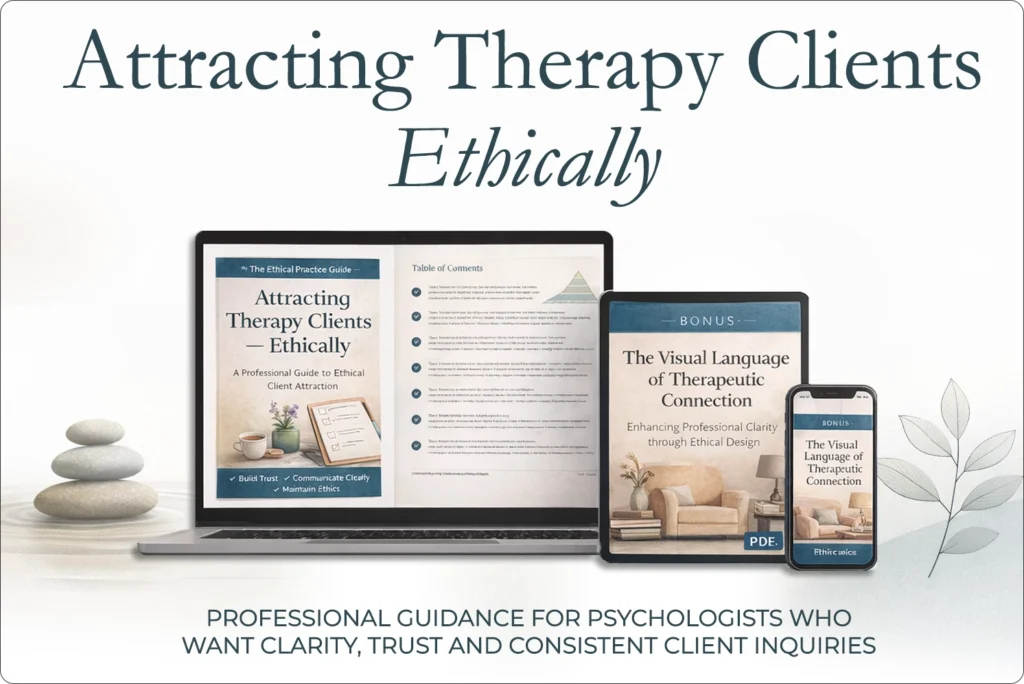
Attracting Therapy Clients — Ethically is a professional guide designed for psychologists and therapists in private practice who want to attract clients with clarity, trust, and ethical boundaries.
It focuses on ethical visibility, informed choice, and trust-based communication — not marketing tactics.
If this approach aligns with how you work, you can explore the full guide below.
Ethical practice does not require invisibility.
Ethics guide how we communicate — not whether we communicate.
Clients deserve clarity, not persuasion.
This guide shows how to offer that clarity before the first session.
Many psychologists want to serve without selling — this guide helps you do both with integrity and clarity.
Attracting Therapy Clients — Ethically
is a professional guide designed to help psychologists communicate their work with clarity, integrity, and ethical boundaries.
It focuses on ethical visibility, trust-based communication, and informed client choice — not marketing tactics.
A note on expectations
Ethical client attraction is not about doing more. It is about reducing confusion, increasing clarity, and allowing clients to choose freely. Growth, when it happens, is a byproduct of alignment — not pressure.
Build visibility that reflects your values — not marketing trends
If this approach aligns with how you work, you can explore the full guide below.
What this guide is NOT
This is not a marketing course.
You won’t learn funnels, persuasion tactics, content calendars, or growth strategies.
You will learn how ethical principles apply to visibility, communication, and first contact with potential clients.
Who this guide is for
Psychologists and therapists in private practice
Professionals who value ethical clarity and boundaries
Practitioners seeking sustainable, long-term practice development
What's included

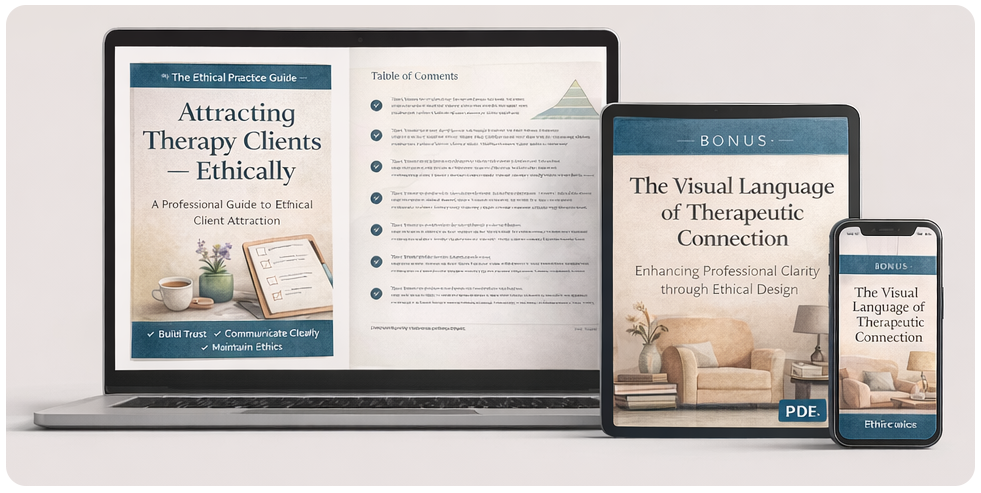
GUIDE
A structured, professional guide designed to help psychologists understand how ethical principles apply before the first session.
This guide explores:
The foundations of ethical visibility
How clients perceive trust and clarity before making contact
Where communication unintentionally creates pressure
How to describe your work without promises or persuasion
The difference between ethical attraction and marketing tactics
Created to support thoughtful decision-making and professional alignment.
WORBOOK
An editable practical workbook designed to help you apply the principles of the guide without turning them into tasks or content obligations.
Through guided reflection, you will:
Clarify your professional focus and boundaries
Refine how you describe your work
Review your client journey with ethical awareness
Identify language that supports informed choice
Create a realistic, sustainable action plan
This workbook supports clarity — not productivity pressure.


BONUS:
The Visual Language of Therapeutic Connection
A practical resource exploring how visual coherence supports trust, safety, and professionalism in therapeutic contexts.
You will understand:
How visual consistency reduces cognitive load
Why calm environments support psychological safety
How visuals influence first impressions without persuasion
Where aesthetics support trust — and where they distract
Visuals are treated as an extension of the therapeutic environment,
not as branding or marketing tools.
Build visibility that reflects your values — not marketing trends.
€ 37
 One-time payment · 7-day unconditional guarantee
 7 full days to explore the material 100% refund if it’s not the right fit No questions, no complications

This guide is designed to support ethical clarity and professional reflection.It does not promise outcomes or client acquisition.
❓ Is this ethical? I don’t want to sell therapy.
+
Yes — and that concern is exactly why this guide exists.
This approach does not teach persuasion, pressure, or self-promotion.
It focuses on clarity, informed choice, and professional boundaries.
You are not selling therapy — you are communicating responsibly and allowing clients to decide freely.
❓ Do I need to use social media for this to work?
+
No. Social media is optional.
This guide does not depend on constant posting, exposure, or online performance.
Many psychologists who use this approach rely on referrals, directories,
and clear professional communication.
If you choose to use social media, it will be minimal and ethical.
If you choose not to, the framework still applies fully.
❓ I already have a website and a professional profile. Is this still useful?
+
Most psychologists already have visibility.
What is often missing is clarity.
This guide helps refine how your work is described,
how inquiries are handled,
and how first contact feels to a potential client.
Small changes in language and structure can significantly increase trust —
without increasing exposure or effort.
❓ Does this guarantee more clients?
+
No — and that is intentional.
Ethical practice cannot promise outcomes.
This guide focuses on alignment:
between how you work in session
and how you communicate before the first session.
Many professionals notice clearer inquiries and better-fit clients over time,
but the priority here is integrity and sustainability.
❓ How do I know if this guide is right for me?
+
This guide is right for you if:
✓ You value ethics and professional boundaries
✓ You feel uncomfortable with traditional marketing
✓ You want clarity, not tactics
✓ You prefer sustainable growth over urgency
If you are looking for fast results or persuasive strategies,
this is not the right product.
If clarity, trust, and alignment matter to you,
this guide was created with professionals like you in mind.